Friday, November 1, 2013

FIFA U-17: Honduras 2 - 1 Sweden

FIFA U-17: Honduras 2 - 1 Sweden

Sweden fought back from a goal down to beat Honduras 2-1 in the final day of action at the Khalifa Bin Zayed Stadium. The Scandinavians, playing in their first FIFA U-17 World Cup, are now through to the semi-finals where they will face either 2011 runners-up Uruguay or mighty Nigeria for a second time at these finals.

The last game from the peaceful desert oasis of Al Ain began slowly. The Swedes, who’ve played three of their four games in Al Ain, had most of the possession. The Hondurans sat back deep waiting for the right moments to burst into the counter-attack and make best use of their superior speed.

Sweden got the first chance after 17 minutes.  A long cross from the left was missed by centre-back Anoal Hernandez, and Valmir Berisha just missed making it 1-0 as he failed to make contact while sliding at full-stretch for the ball. Ten minutes later and again it was the Scandinavians going close when Captain Linus Wahlqvist rose highest in the penalty area only to smack his powerful header against the bar.

Those misses came back to haunt the Swedes too. Predictably Honduras’ opener came on the break. A long, hopeful ball from deep in midfield picked out Brayan Velasquez racing into space. He muscled his way past Erdal Rakip and Johan Ramhorn couldn’t quite cover the danger, as his sliding challenge was too late. Velasquez clipped the ball into the top corner from a tight angle while off balance. It was the Central Americans’ first shot on goal.

The Hondurans came out in the second half trying to slow the game down and protect their slim lead. But after 68 minutes, Swedish patience and determination paid off. Pressing at the edge of the Honduran box, Gentrit Citaku flicked a delicate through ball into the penalty area for Erdal Rakip, who made no mistake with a cool slotted finish past Hernandez to draw the scores level.

Sweden coach Roland Larsson decided to go straight for the jugular, making an attacking double substitution minutes after his side drew level. In came Anton Saletros and Carlos Strandberg just before the goal fell to inject a little extra pace. And they had an immediate, and profound, impact on the proceedings.

Strandberg broke up the right and put a cross-field ball over to the left for Saletros, wbo pulled it back across the face of goal. The service was a little behind Berishia, but the combative forward who models his game after Zlatan Ibrahimovic, let it run through his legs and flicked home into the side netting with his heel.

Honduras pressed and pressed in the dying minutes of the game, but they couldn’t find the goal that would have kept their Cinderella run here in UAE going. Instead, it’s the debutant Swedes who are heading for dreamland and a date with either Uruguay or Nigeria in the semi-finals.

Tuesday, October 29, 2013

YABA COLLEGE OF TECHNOLOGY ACCEPTANCE, ADMISSION STATUS AND LIST CHECK

Friday, October 25, 2013

Samsung Galaxy S3 outpaces iPhone 5S, 5C in touch accuracy

Apple's iPhone 5S and iPhone 5C have a bit of improving to do on the touch-accuracy front, according to new data from OptoFidelity, a Finland-based tech test and measurement company.
OptoFidelity said that it used its own Touch Panel Performance Tester to measure the iPhone 5C, iPhone 5S, and Samsung Galaxy S3. The device uses a robot to "touch" exact coordinates on a screen. It then measures the coordinates of the touch device to see how closely they matched.


According to the data (PDF), the iPhone 5S and iPhone 5C had significant fail rates, especially around the edges and toward the top of their displays. The Samsung Galaxy S3, meanwhile, was largely accurate across the middle of the screen, but had errors around the edges.
From there, OptoFidelity turned its attention to the virtual keyboard on the three devices and again found that Samsung's device is far more accurate in its response to touch inputs.
"Because the touch accuracy is more even in Galaxy S3 than in iPhone 5S and iPhone 5C, you get a lot less typing errors, and letters which are close to the edge are working better," OptoFidelity said in its report. "You can also test this by tapping letters on the edge and typing long text messages."
OptoFidelity didn't say why it didn't include the Galaxy S4 in its study.

Related stories
Off-contract iPhone 5S, 5C come to Cricket
iPhone 5S now in even shorter supply, says analyst
iPhone 5C, 5S too pricey for Russian shoppers, report says
Tweetbot 3 for iPhone gets redesigned and a rise in price
Apple updates Podcasts, Find My iPhone apps

Thursday, October 24, 2013

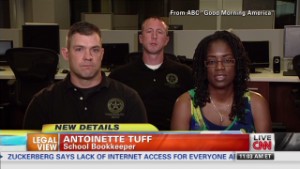
Does your child's school have a security plan?

John Matthews
John Matthews

1. Does the school have a crisis response plan customized for its campus?

Over the last decade, many states have mandated that schools have crisis response plans. This sounds like a good idea in theory. But because they were mandated, many schools have simply copied generic plans provided by the state or another school district in order to meet their legal requirements. Make sure that your school has a crisis response plan that has been specifically designed for its unique characteristics, demographics and personnel.

2. Does your campus regularly practice school safety drills?
If your campus does not regularly practice basic school safety drills such as lockdowns, shelter-in-place and evacuations, ask the administrators why not? There is no good reason they can give you for not being prepared. The old adage "practice makes perfect" not only applies to reading, writing and arithmetic. Most school safety experts advise campuses to practice such drills at least once per semester with teachers and school staff also drilling during in-service training days.
3. What should parents do if there is an emergency at the school?

"They were all surrounding him"
Entire Georgia school shooting 911 call
Your school should be providing you with information regarding your role as a parent during a school crisis. Whom do you call? Where do you go? What do you when you get there? What documents do you need to bring, if any? Many school districts require all parents to show proper identification to pick up their child after a "nontraditional release" such as an evacuation. Make sure you know the school and districts policies for such an incident.

4. Have both staff and students received training on what to do during an active shooter incident?
It is imperative that administrators and teachers know what to do during a school crisis but it is equally as important for students to know what to do to survive an incident. Demand to know exactly what training is provided to staff and students. Does the school provide materials so you can discuss the training with your child and provide additional practice if necessary?

5. Has the school partnered with its local law enforcement agency to practice emergency response procedures?
Although many schools have crisis response plans, most have not taken time to personally work with their local law enforcement agencies to co-develop plans and practice drills. Real-time practice scenarios are essential to a comprehensive school safety plan. When school and law enforcement plans are not in sync with each other, important procedures that could save lives may be missing.
We can never predict when something terrible will happen. But the least that you can do as a parent is to make sure your child's school has taken the necessary measures to act in the safest and best possible way should an unanticipated disaster -- such as a shooting -- occur.

Sunday, October 20, 2013

ASUP starts strike on Friday

The Academic Staff Union of Polytechnics is to resume its suspended strike on Friday  following  the inability of the Federal Government to resolve outstanding issues with the union.
ASUP Chairman, Mr. Clement Chirman, told newsmen in Jos on Sunday that “the frustrating inertia of the Federal Government to convincingly fulfil any of the promises and agreements reached with the union before the suspension of the earlier strike on July 172013 shows that government is not serious.”
Chirman said the National Executive Council after its 75th meeting held at the Federal Polytechnic, Bida, Niger State, resolved that the strike would “be total and indefinite” until  the government showed  committed to honouring the agreement with the union.
He expressed dismay at  government penchant  for breaking agreements, adding that “since the union suspended its earlier strike in July, government has shown no commitment to fulfilling any of the promises it made to the union.”
The union in its communiqué after the meeting in Bida decried “the anti-labour stance of the National Assembly as exemplified by the recently proposed removal of minimum wage from the exclusive legislative list of the constitution to the concurrent list, as well as the proposed legislation against declaration of industrial strike by unions in the tertiary sector.”
ASUP also lamented government’s abuse of the laws establishing TETfund. And the culpable lack of commitment of the National Board for Technical Education to meeting the needs and demands of polytechnic education in Nigeria.
“The CONTISS 15 Migration for Lower cadres, Needs Assessment of Polytechnics, release of whitepaper of visitation to Federal polytechnics, discrimination between polytechnics and university graduates in job placement and career progression and the constitution of Governing Councils to Federal polytechnics earlier omitted, were among the issues we brought before the Federal Government in the last negotiation, but government has failed to address any of them since after we suspended strike in July”, Chirman lamented.
The communique said:
1. That Government should without delay address all the outstanding standing issues including the NEEDS Assessments of the polytechnics and the corresponding funding, constitution of the Governing Councils of the remaining Federal polytechnics, CONITSS 15 Migration of the Lower Cadres, the removal of disparity between HND and Degree certificates, establishment of the National Polytechnics Commission (NPC), release of the Whitepaper of the visitation panels to polytechnics;
2. That the National Assembly should rescind from its current anti-labour posture in the interest of industrial peace and our desperate move to rescue the endangered soul of the tertiary institutions in the country;
3. That the National Assembly should expedite action on the review of the Polytechnic Act;
4. That a vote of no confidence be passed the NBTE and further calls for the immediate establishment of a National Polytechnics Commission (NPC) to proactively cater for the needs of the sector;
5. That the Nigerian political class and other interest groups should exercise restraint on their utterances and activities in the interest of peace, unity and security of the nation;
6. That the Federal Government should desist from abuse of TETfund laws;
7. That stakeholders in the education sector such as parents, students, religious leaders, the press, members of States and National assemblies to rise to their responsibilities of rescuing the (polytechnic) education sector from imminent collapse;
8. That the position of ASUP on the need to appoint the rectors from within the polytechnic system remains irreversible;
9. That in view of the continued insincerity of Government to honour the agreement reached with ASUP, NEC resolves that the union will resume the suspended strike with effect from 4th October, 2013. NEC sincerely appreciates the good people of Nigeria and all other stakeholders in the education sector for their sustained support in its struggles to save the polytechnic education from total collapse in Nigeria.

PAGEVIEWS

ARCHIVE